

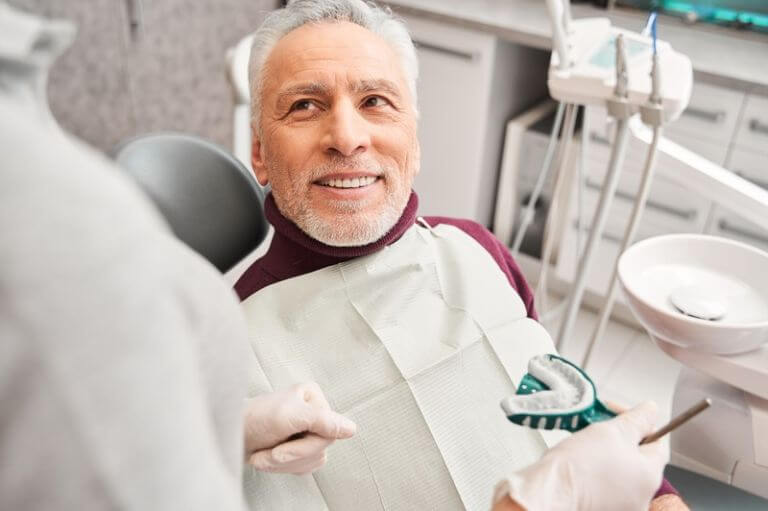
Do You Need a Bone Graft Before Dental Implants?
If you’ve been told you might need a bone graft before a dental implant, it can feel as if the goalposts have moved. You came in to replace a tooth, and now there’s an extra step. The good news is that grafting is a routine part of implant dentistry, and for many patients it’s the very thing that makes an implant possible.
Here’s what a bone graft actually does, who tends to need one, and how it changes your treatment timeline.
Why Bone Matters for an Implant
A dental implant is a small titanium post that sits in your jawbone and takes the place of a tooth root. To stay secure for the long term, it needs enough healthy bone around it, in both height and width. Think of a fence post. Set it in shallow, crumbly ground, and it won’t hold, however well it’s made.
The catch is that jawbone doesn’t stay the same once a tooth has gone. Without a root to support it, and without the pressure of biting and chewing, the bone in that spot gradually shrinks back. Much of that change happens in the months after an extraction, and it carries on slowly after that. Someone who lost a tooth ten years ago will often have noticeably less bone at that site than someone who lost one last month.
Who Is More Likely to Need a Graft
- Teeth that have been missing for several years
- A tooth lost to gum disease, which tends to destroy the supporting bone first
- An infection or abscess at the site before the tooth came out
- A difficult extraction where some bone was lost along with the tooth
- Upper back teeth, where the sinus sits just above the jaw and there may be little height to work with
- Long-term denture wear, which can speed up bone loss underneath
None of these automatically means you’ll need grafting. Plenty of patients with a long-standing gap have enough bone, and some with a recent extraction don’t. The only way to know is to look properly.
How We Find Out
Dr Ramon Badalbit leads every implant case at 19 Wimpole Street from the first consultation. He’s a GDC-registered Prosthodontics Specialist (GDC 70207) with more than 30 years’ experience, and a big part of his job is planning the finished tooth before anything is placed.
During your implant consultation, he’ll examine the area, go through your dental and medical history, and use X-ray imaging to measure the bone that’s there. That tells us whether an implant can go straight in, whether a small amount of grafting can be done alongside it, or whether the site needs building up first.
The Main Types of Bone Graft
Grafting at the same time as the implant. If the shortfall is small, graft material can be placed around the implant during the same procedure. For many patients, this adds little or nothing to the overall healing time.
Socket preservation. If a tooth is being removed and you’d like an implant later, graft material can go into the empty socket straight away. This helps limit the shrinkage that would otherwise happen while the area heals.
Ridge augmentation. Where the jaw has become too thin or too low, a larger graft rebuilds it before the implant goes in. This is a separate step, and the new bone needs time to mature.
Sinus lift. In the upper back jaw, the sinus membrane is gently lifted, and graft material is placed beneath it to create the height an implant needs.
Graft materials vary. Some are synthetic, some are processed from animal sources, and occasionally a small amount of your own bone is used. We’ll explain which suits your case and why.
What It Means for Your Timeline
This is usually the part people want to know most. A minor graft placed with the implant tends to keep you on a similar schedule to standard implant treatment, which at our practice often takes three to six months from start to finished crown.
A larger graft placed in advance adds a healing stage. Patient guidance from Cambridge University Hospitals NHS Foundation Trust explains that more extensive grafting is carried out at least four months before the implant is placed, and bigger reconstructions can take longer. So if you need ridge augmentation or a sinus lift, it’s realistic to plan for several extra months.
That can feel like a long wait, but rushing it would be a false economy. An implant placed into bone that hasn’t matured is at greater risk of failing, and a failed implant costs you far more time than the graft ever would.
Does a Bone Graft Hurt?
Grafting is carried out under local anaesthetic, so you shouldn’t feel pain during the procedure. Afterwards, expect some swelling and tenderness for the first few days, much like recovering from an extraction. Most people manage comfortably with standard painkillers and are back at work within a day or two. Smoking slows bone healing considerably, so if you smoke, this is a very good time to stop.
Planning an Implant in the Future?
If a tooth needs to come out and you think you’d like an implant eventually, tell us before the extraction. Planning ahead means we can protect the bone at the time, which can make the implant stage simpler later on.
The same goes if you’ve had a gap for a while. Don’t assume you’ve left it too late. Grafting means many patients who were once told implants weren’t an option can now have them.
Book an Implant Consultation in Marylebone
Whether you need a graft or not, the first step is a proper assessment. Book a consultation at 19 Wimpole Street Dental Practice, and Dr Badalbit will talk you through your options and your timeline, with an itemised quote that sets out any grafting separately so you know exactly what you’re paying for.